
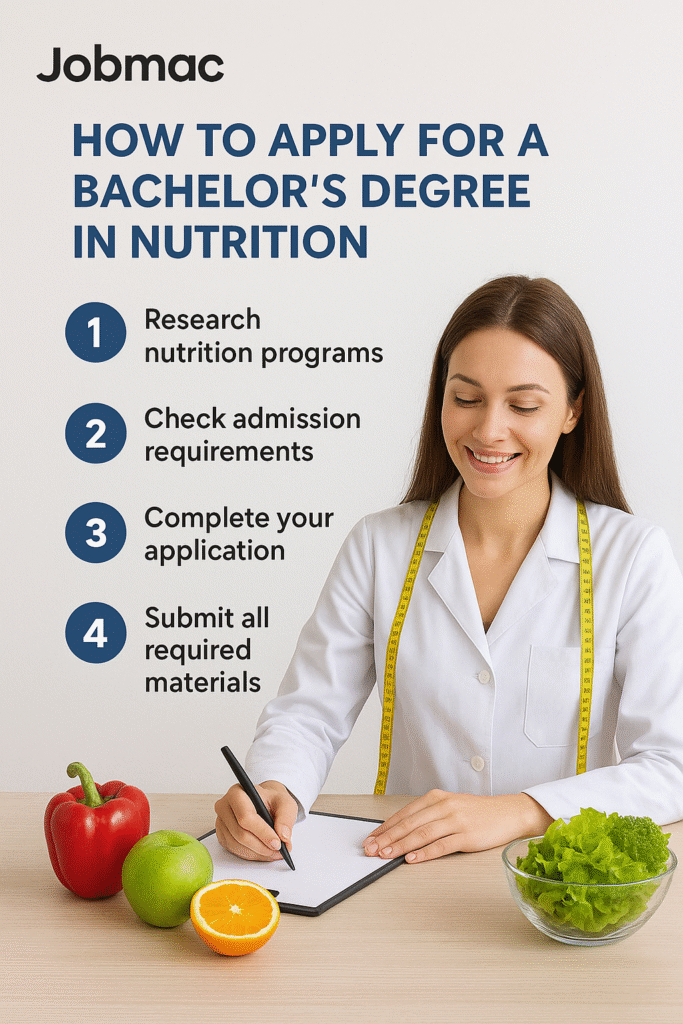
This article How to Apply for a Bachelor’s Degree in Nutrition: Step-by-Step Guide was written to bridge the gap between the university and the students aspiring to gain admission to study food and nutrition in any university around the world
The need for health and wellness professionals is increasing because people are always looking for ways to live a healthy life.
A nutritionist plays a vital role in an individual’s life, such as helping them manage their weight, manage chronic illnesses, and achieve other set goals. This is all the more reason why students are seeking to earn their degree in nutrition.
With an increase in the rate at which students apply for the programme, gaining admission to study nutrition becomes competitive , thereby making a strong application more relevant than ever.
Acquiring a bachelor’s in Nutrition opens a door to a career in the health care sector, food service, research, and counseling.
This field of study paves the way towards becoming a Registered Dietitian Nutritionist (RDN), a certification that requires an accredited degree and well-supervised practice. Keep reading to know how your application as a nutritionist will stand out
Understanding the Requirements for a Bachelor’s Degree in Nutrition
Before you begin to apply for any university course, including a nutrition program, you must know what the university wants from you being an applicant.
Some programmes do have minimum academic requirements. Here, you look for the courses that are mixed with science, and also check for program accreditation that offers a license and job options
Course Academic Prerequisite and CGPA
Some universities want to see a very strong achievement in your high school, especially in courses like biology, chemistry, and mathematics. The school will set its own CGPA, but it is found that 3.0 or higher is common for programmes that are competitive
There are schools that require SAT or ACT scores, while most of the schools have moved to test-optional policies.
Having good grades in your science courses gives you an edge over your competitors and also tells the institution that you’re ready for college-level study in nutrition.
Other requirements include:
- High school academic result like diploma and a GED
- Evidence showing that you have completed some basic science courses like Biology, Chemistry, and some part of physics
- Proficiency in mathematics
- Minimum CGPA of 3.0, but it varies sometimes depending on the school’s decision
- Having a higher grade where it counts can make you stand out among other applicants. Try to get feedback about your transcript before applying. You should be mindful of raising the grades in weak areas or where it will give you more advantage
University and Course Accreditation
It will be very important for you to know that it is not every programme that gives you the line for future certification and licensure. That is why you must try to find an institution that is accredited by organizations like the Accreditation Council for Education in Nutrition and Dietetics (ACEND) .
It is only those who graduated from an accredited university and programme can proceed to a dietetic internship, which is compulsory before becoming an RDN.
Programme Accreditation gives Assurance on
- Course eligibility for licensing and the RDN exam
- A good internship and job placement
- Confident employers trust your education
Step-by-Step Application Process for a Nutrition Degree
A good and strong application gives you the passport to a top nutrition programme; it pays off when you plan well. Below is the practical guide that helps you to be on track
.
Researching and Shortlisting Nutrition Programs
The first thing is to carry out your research on available nutrition schools, begin with accredited schools, their locations, tuition, labs, and internship opportunities. You may have an interest in the programme that focuses on sports nutrition, community health, and food science
Steps in Building your shortlist:
- Compare reviews and rankings
- Consider tuition like in-state and out-of-state tuition
- Check the course specialist that you would like to delve into
- Research about campus activities and resources
Thinking about the programme that you need to take up, either full-time or part-time, online. You can visit the platform NutritionEd to get more details.
Preparing Important Application Material
Be sure to gather all the necessary materials you will need before the application commences properly. Institution requirement varies, but most programmes request for:
- Completed online application
- High school transcript that is
- Standardized test score from SAT or ACT if the need be
- Letter of recommendation from persons like the science teacher, employers, or a coach
- Applicant’s personal statement ( why you want to study nutrition and your career goal.
- Evidence of extracurricular, community service, or related experience ( optional, but has its own advantage)
While writing your personal statement, be honest and genuine. Point out your real passion for health, science, and helping others
Be honest and genuine in your personal statement. Highlight a real passion for health, science, and helping others.
Submitting Your Application and Meeting Deadlines
Mark important deadlines on your calendar or write them down in a place you will always see and remember them.
Most of the nutrition schools make use of online submission, which may require you to send your transcript separately. Ensure that every document, including recommendations, is uploaded successfully
There may be need for you to pay an application fee; it will be necessary to include all this in planning . Students do qualify for a fee waiver, but you must identify with the school first
How to stay organised while Applying for a Bachelor’s Degree in Nutrition
- Make a list of deadlines for the schools you apply to
- Create a reminder a week in advance for key steps
- Seek the counselor’s advice if confused
- Keep copies of all your submitted documents for future reference
Financing Your Nutrition Degree
Studying nutrition at the university requires a lot of money; here, budgeting matters a lot from the beginning.
Tuition fees vary from school and state. Always have it at the back of your mind that there are other costs like books, lab fees, and living expenses
Funding Opportunities available for students
- Scholarship ( merit or need-based)
- Federal and state grants ( but you need to fill out the FAFSA form early)
- Students loans
- Jobs like part-time or work study programmes
- Internship with stipend
It is advisable to apply for several opportunities or scholarships, even small ones, because the cost of things do add up.
School do offer their aid and scholarship based on your applications. That is why it is good to indicate your interest in a scholarship during your applications.
Note: FAFSA season begins in the fall, and early filers do have an advantage over monetary grants. So mark your calendar and make ready all your financial documents very early
Opportunities and Salary Range in a Growing Field
As we all know that nutrition is not just about the meal schedule and weight loss. This field of study is so wide in relation to jobs in medical sectors, public health, food companies, research and sports.
With emergence of more health challenges coming into the focus, new role keeps appearing especially the one related to food allergies, chronic and healthy aging
Roles of Clinical Nutritionist and Dietitian
The work of clinical nutritionist and registered dietitians most times ends in the hospital, clinics, private practices and nursing homes.
The major job of the clinical nutritionist is to help people that has medical issues, imaging a nutritionist guiding a patient with heart disease , diabeties, kidney issues and digestive disorder through a safe and effective diet
Some of them also works in a hospital or places that specializes in taking care of pregnant women, children and the elderly ones
.
Key settings where a Nutritionist can work
- Hospitals and clinics
- Outpatient centers
- Home healthcare agencies
Public Health and Community Nutrition job
One of the major work of public health and nutrition is to guide the whole community at large on how to eat healthy and prevent disease.
They do treat topics ranging from food safety, childhood hunger, and diabetics prevention. A lot of them work for government agencies, school districts non-profit organizations like unicef and public clinics
Community nutrition programs tends to look into groups with much needs like low income families, immigrants, at risk or vulnerable children. Most of them advocate for improving school lunches or introducing cooking demos at local food banks
Common Places That Nutritionist are Employed
- State and Local health departmmnts
- WIC i.e Women, infant and Children ) programmes
- Non-Profit organizations like NGOs and Unicef
- Nutrition in sports, Fitness and Wellness
Nutrition In Sports and Wellness
Nutrition in the area of sports and wellness inculcate science in gyms, fitness studios, sports team and wellness retreats. Sports nutritionist helps the athletes to improve in their workouts, speed up recovery and stay at a healthy weight.
Some work with college while other work as consultants where clients meet them face to face
Often times, dieticians are being hired by wellness centers and coporate wellness programmes to run a health challenges , host seminars or structure the company wide nutrition plans
All these jobs allows you to combine passion for fitness with technical knowledge on how the body works at its best
Key areas that Nutritionist and Dietician work:
• Athletic teams
• Fitness centers and gyms
• Yoga studios and spas
• Corporate wellness initiatives
Research, Academia, and Food Industry Path
This area is meant for those that loves solving puzzles, teaching and researching in academic.
Nutrition researcher working in this field of research, academia and food industry will test how the food impacts health, also try out new diets and examines public health. This type of people works in the universities, government agencies or in private lab like those companies producing processed food.
Teaching in universities or college requires a certain level of qualification like masters degree and doctorate degree. To some, they function in teaching the next generation of dietician , while others write books or design online courses
Nutritionist works at food companies , where they create and market new product, examine labels and make sure that the food is safe for consumption. Some of them work in the regulatory affairs to make sure that companies follow local health rules
Levels and Roles a Nutritionist can Achieve
- University professor or lecturer
- Clinical researcher
- Food scientist or product developer
- Regulatory or compliance officer
Professional Growth and Salary Ranges of Nutritionist
Salary and income of a nutritionist varies, depending on some factors like job title, experience, education, work place and the location. Some tracks like clinical nutritionist pays heavely while others like consulting doesn’t pay that much
Entry-Level and Median Salaries
Below is the quick glance of starting and average salaries in nutrition according to 2023 USA data
Job Title Entry-Level Salary Median Salary
Registered Dietitian 47,000 67,000
Clinical Nutritionist $46,000 $64,000
Public Health Nutritionist $43,000 $61,000
Sports Nutritionist $45,000 $62,000
Food Scientist/Product Developer $50,000 $75,000
Nutrition Educator/Community Lead $41,000 $58,000
It is observed that wages increased depends on the degree, certificate and experience of the individual.
Sector and Regional Based Salary Changes
Salary varies depending on the individual locations, the company, employer and the population currently serving
Urban vs rural: Large cities do pays well but the cost of living higher, a good example is people working in companies located in New York City and Florida earns higher than those working in other small state
Sector: Nutritionists working in the private consulting and food sectors earns more than those working in the public health or non-profit company
Specialization: Those dieticians working in different niches like ( sports nutrition, pediatrics and oncology) can boast more earning power
A very good example is, dietician working in a companies located at New York, Massachusetts and California do earn higher up to 15-25% above normal national wages.
Those working for federal government agencies or big coporations also earns higher
.
Advancement, Specialization, and Earning Potential
Career growth in nutrition is all about proceeding with skill building and further education. Some deticians and nutritionist starts with bachelors degree and then move towards acquiring advance roles with more training
Ways to boost earnings and career options:
Apply further for your masters or doctorate degree in nutrition, public health, or related field
Try and get more credentials and certificates to support the ones you have e.g are Certified Care and Education Specialist, Certified Specialist in Sports Dietician etc
Create a private practice that are highly needed in your discipline( guth health, food allergies and functional nutrition)
Go into management, corporate consulting or education
Research shows that those who are good in special practice with loyal clients can make up to six figure income after one year. The authors, speakers or TV presenters often make higher income
Conclusion
Getting admission to study nutrition in the university is a nice approach towards a rewarding career that shapes science and care for others. Having discovered that the health sector is becoming a bigger priority than ever, well-trained and qualified nutritionists are in demand in hospitals, schools, wellness, and even research laboratories
Proper planning and attention to detail can distinguish your application, apart from being in a competitive process since you are applying for accredited programmes connected to strong outcomes
Upon receiving your admission letter check what the next step is, which may be registering for classes, planning your first semester, checking out campus clubs, or professional organizations.
If you really want a role that will help you get to your best, begin a career with a bachelor’s in nutrition, a very nice and smart step for your future
To get more information on how to succeed as a nutrition specialist, start learning about internship requirements and career pathways, and check on the key sources from sites like NutritionEd.org and the Academy of Nutrition and Dietetics. Your new career in nutrition can start with the right application strategy.
![MIT Scholarships Guide [2025]: How to Apply and Win](https://jobmac.org/wp-content/uploads/2025/08/file_0000000038b46243b0f0c5fe02a3d783-1024x683.png "MIT Scholarships Guide [2025]: How to Apply and Win")