
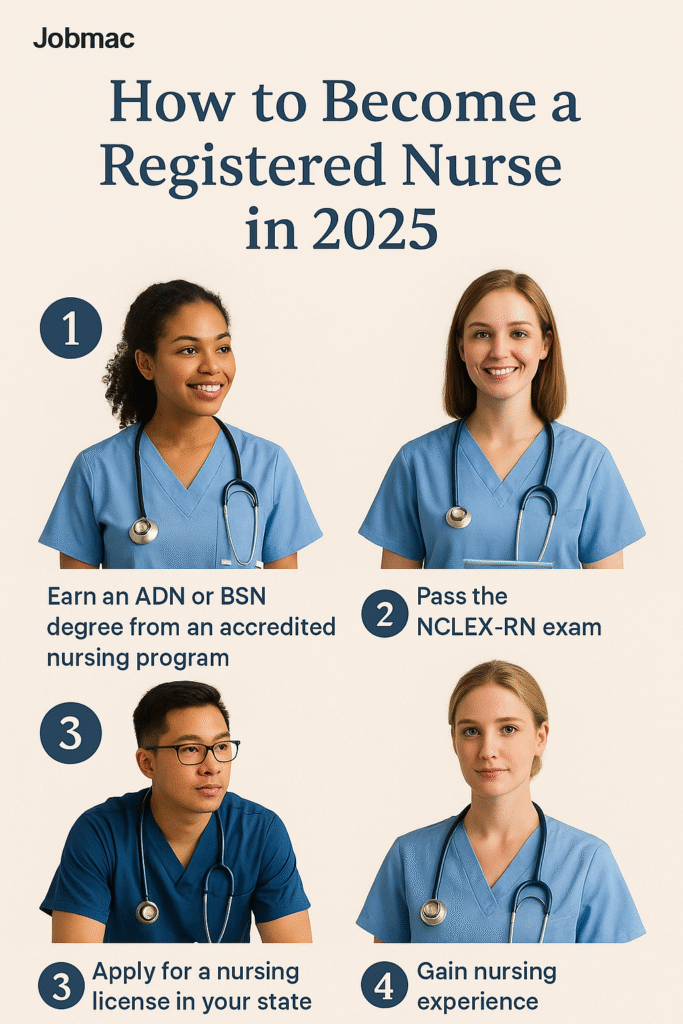
Hospitals and clinics are in need of more nurses in 2025, and the trend has been a consistent one. The Bureau of Labour Statistics projects 6 percent job growth for RNs from 2022 to 2032, with about 193,100 openings every year.
Aging patients, chronic conditions, and retirements make the demand high. If you want a job that is stable, purposeful and offers strong pay, this profession is a clear path for you.
This guide completely explains how to become a registered nurse in 2025, step by step. You will also see how to choose the right education, complete clinical training, pass your exam, and get your nursing license. Furthermore more you will learn how to start your first role and grow faster.
First thing is to make a selection between your programs, such as an AND or BSN. An AND gets you into the field sooner, while a BSN can open more doors. Both include clinical hours that build skills and confidence.
The next thing is to prepare for and pass the NCLEX-RN. Then apply for your state license and complete background checks. Plan your job search early, build a focused resume and practice for behavioral and clinical interviews.
Once employed, make use of your nursing residency or mentorship if provided. Pick up a unit that fits your goals, such as med-surg, ICU, ER,or pediatrics. If you want to advance , earn a certificate that matches your unit.
You can expand your nursing career path with advanced roles. Consider BSN completion, MSN, or APRNs later on, such as an NP or CRNA, if that fits your plan. Keep CEUs current and track renewal dates so you stay licensed and ready.
Having gotten the major requirements, it’s now time to act. You get steady demand, many settings to choose from and real impact with every shift. The steps are clear, the process is reachable, and support is available at every stage.
Keep reading to map your timeline, pick the right school, master the NCLEX, and move from new grade to confident RN in 2025
Meet the Basic Requirements Before You Begin
Before you pick a program or plan your NCLEX timeline, confirm you meet the basics. These are the gatekeepers for nursing school admission, clinical placement and state licensure. Getting them in order now saves weeks later.
You can review the national guidance from the American Nurses Association to see the broader path to RN practice in the US. The overview here aligns with the ANA’s steps to become an RN. See the ANA’s guide: Learn How to Become a Registered Nurse | ANA Enterprise.
1.Age, Education, and Legal Prerequisites
Start with the must-have. Use these steps to confirm eligibility and avoid delays.
Create a simple checklist with dates for each item above. Add deadlines from your target schools. This keeps you on pace while you balance work, family or other courses.
2.Develop the Core Skills Nurses Need Today
Strong nurses pair people skills with clinical basics. Build these before day one. You will feel more confident in class and safer in clinicals
Soft skills to practice now
- Communication: Speak clearly, listen fully, and repeat key points. Example: SBAR-style updates when you call a clinic or report an issue at work
- Empathy: Acknowledge feelings, not just facts. Try “I hear that you are worried about the pain. Let us talk about what helps.”
- Teamwork: Nursing is teamwork. Be punctual, share tasks and close loops. If you cover a task, say it out loud and document it.
- Stress management: Use short resets. Box breathing for one minute helps during a busy shift or simulation.
- Attention to detail: Double check names, allergies and doses. Build this habit now by verifying details in everyday tasks.
Technical foundations to build:
- Basic medical knowledge: learn vital signs, standard ranges, infection control and common chronic conditions. Short study sessions work best.
- Math for meds: Practice ratios, conversions, and IV drip rate problems. Aims for accuracy first, speed later
- Digital literacy: you will use electronic health records, bar-code scanning and telehealth tools. Get comfortable with secure logins, templates, drop-down fields and error alerts.
- Clinical safety mindset: Think “rights” of medication administration, fall risks, hand hygiene and isolation precautions. Make safety your default.
- Simple ways to build these skills before formal training:
- Volunteer in a hospital, clinic, hospice, or long-term care facility. Focus on patient comfort, rounding and communication.
- Work as a CNA or patient care tech if possible. You will gain hands-on skills, speed and teamwork under supervision.
- Shadow nurses in a unit that interests you. Watch how they prioritize care and coordinate with the team.
- Take short courses in CPR/BLS, medical terminology, and HIPAA. This reduces the learning in your first term.
- Use daily life to practice: Explain a complex topic in simple words, write clear emails, and manage a to-do list like a patient load.
Keep the 2025 workplace in mind. Nurses today chart in EHRs, support telehealth visits and use smart pumps and scanners. Build your comfort with technology now. It pays off in clinical and during orientations.
If you want a quick benchmark for your readiness, compare your skills to the ANA’s overview of RN preparation and competencies Learn How to Become a Registered Nurse | ANA Enterprise.
Select and Complete Your Nursing Education Program
Your choice of education sets your pace, cost and early career options. Pick the path that matches your timeline and goals, then plan a clean application process.
Many regions in 2025 favour BSN-prepared nurses for hospital roles, leadership tracks, and residency programs, while AND programs still offer a fast offer, affordable entry into practice
ADN vs. BSN: Which Path Fits Your Goals?
Both routes lead to the NCLEX-RN and entry-level RN roles. The right choice depends on how fast you want to start your budget and long-term plans, like advanced practice or leadership.
Key differences and trends:
- An AND typically takes about 22 years at a community or technical college.
- A BSN usually takes about 4 years at a university or through an accelerated option if you hold a prior degree.
- Some hospitals and regions in 2025 post BSN-preferred or BSN-required job listings, especially in acute care and magnet-recognized systems. See a clear comparison of coursework scope and future opportunities in the ANA’s overview, ADN vs. BSN: Which Is Right for You?.
Pros and cons to consider:
- ADN benefits:
- Faster entry to practice
- Lower tuition at many community colleges
- Strong path for local employers and long-term care settings
- ADN trade-offs:
- Fewer options for leadership or public health roles
- Some hospitals prefer BSN for residencies or specialty units.
- You may need a later RN-to-BSN to stay competitive.
- BSN benefits:
- Wider access to hospital roles, specialty units and residencies
- Strong base in research, leadership and community health
- Smoother path to MSN, APRN, or management later
- BSN trade-offs:
- Higher tuition at most universities
- More time before earning RN pay if you start from zero.
- Smart middle paths:
- Start with an AND, work as an RN, then complete an RN-to-BSN online in 12 to 18 months.
- Pursue an accelerated BSNN if you have a bachelor’s in another field.
- Compare total cost, clinical placement quality and NCLEX pass rates. For a practical breakdown of the program differences, refer to the nursing journal guide to RN Diploma vs. ADN vs. BSN.
- Bottom line, if you want the fastest route to RN, choose AND with a clear plan to bridge. If you want broader roles and leadership potential, go straight to BSN.
Top Tips for Applying to Nursing Schools in 2025
Admission is competitive in many states this year. A clean , early application is your best advantage. Aim for accuracy, complete files and clinical exposure that proves your fit.
Core application steps:
- Complete prerequisite with strong grades, especially in anatomy, physiology and microbiology.
- Take the entrance exam if required. Many programs use the TEAS or HESI A2.
- Write a focused essay. Share a specific patient interaction, a service experience, or a challenge you solved that relates to nursing.
- Secure recommendations. Ask instructors and healthcare supervisors who can speak to your reliability, communications and teamwork.
- Prepare for the interview if the program includes them. Practice brief clinical scenarios, ethical questions, and why you chose their school
Stand out in a tight applicant pool:
- Include clinical exposure. Volunteer in a hospital, long-term care facility, or public health clinic. Even 4 to 6 hours a week sends a strong signal.
- Work as a CNA or patient care tech if possible. Direct care experience shows commitment and skill with patients.
- Show academic momentum. Retake key science if they are older than 5 years or below a program’s preferred grade.
- Highlight service and leadership. Includes roles in clubs, military service, community outreach or tutoring
- Keep track of your resume scannable. Use clear headings and quantify results, such as volunteer hours or improvement projects.
Plan for waitlists and backups:
Community college can be more affordable and may have shorter waits in some districts.
Apply to several programs at different times. Include at least one rolling admission option.
Meet all deadlines for immunizations, background checks and CTR certifications so you can accept a last-minute seat.
If waitlisted , send an updated transcript or a brief note about the new healthcare experience.
What admissions teams look for:
Academic readiness in the sciences and the amount of meals
Communication skills that fit patient care and teamwork
Reliability with deadlines, clinical compliance and professional behaviour
Clearer reason for nursing and realistic view of the work
Sample application timeline:
- 9-12 months before start: Research programs, compare AND and BSN, map prerequisites, and meet advisor
- 6-9 months before start: Take the TEAS or HESI if required, request transcripts and line up references
- 4-6 months before start: submit applications, write essays and complete interviews, apply for FAFSA and scholarships
- 2-4 months before start: Respond to offers, complete health and background clearances and attend orientation
- 1 month before start: Buy required supplies, confirm clinical dress code, and set a study schedule
Essays that work:
Lead with a short story that shows empathy, safety or teamwork.
Tie your story to program value or mission.
Close with a forward view, such as regional health needs or your plan to serve in a high-need unit.
Final checks before you hit submit:
- Verify name and contact details on every document.
- Match your essay and resume dates to your transcripts and work history.
- Confirm prerequisite completion dates and grades.
- Review program-specific rules for retakes, science courses, age limits, and minimum GPAs
- If you need a quick refresher on how degree paths affect future roles and pay, visit ADN vs. BSN differences
- Clinical rotation rearranges classroom knowledge into safer patient care. You will build skills, judgment and confidence while working with real teams.
- By the end, you should manage a small patient load under supervision and communicate like a new nurse. For a clear overview of the expectation, review the ANA guide on what to expect during clinicals.
What to Expect During Your Clinical Placements
You will start your day by receiving an assignment from your instructor or preceptor. You will review charts, introduce yourself to patients, and plan care.
Early on, you handle one patient. As your skills grow, you also progress. Many programs expect you to perform basic assessments, charts, findings, and give a report. See common expectations by term in this practical BSN clinical rotations guide.
Core daily activities include:
- Patient care: Morning care, mobility, safe transfers, repositioning, and fall risk checks
- Vital signs and assessments: BP measurement, pulse, respiration, temperature, Sp02, pain and document trends
- Medication administration: Prepare and administer medications under supervision, confirm the rights of medication safety and allergies
- Wound and device care: Observe dressing changes, IV site checks and enteral feeding care, then assist as allowed
- Charting and SBAR: Documents timely and gives focused updates to nurses and providers using a clear SBAR format.
- Teamwork: Work with CNAs, therapists and case managers to meet the plan of care. Emotional impact is part of clinical learning.
- You may see distress, grief or anger. Ground yourself with simple practices.
- Center before care: One minute of slow breathing resets your focus
- Name feelings: Say to yourself, “ I feel nervous,” then run to the task at hand.
- Debrief: Share tough moments with your instructor after the shift. Ask for feedback on what went well and what to try next time
Professional preparation makes every shift smoother:
- Uniform and gear: Clean scrubs, closed-toe shoes, penlight, watch with a second hand, black pens, small notebook
- Readiness: Review common meds on your patients, MAR the night before and look up side effects
- Professionalism: Arrive early, keep patient info private, offer help, and thank staff who teach you
- Mindset: Treat clinical like a job. Be curious, ask precise questions and follow up on tasks you will start soon
Example: when your patient is feeling dizzy. You will first check vitals, verify orthostatic BP, hold a standing ambulation attempt, notify the nurse using SBAR, and document the change. Safety first, then clear communication.
Overcoming Common Challenges in Clinical Training
Clinical training pushes you. It tests stamina, communication, and clinical judgment. Facing common hurdles with a plan keeps you on track.
Frequent challenges and practical responses:
- Fatigue: Early morning drains energy and long shifts. Prepare meals ahead, hydrate, and keep a small snack. Use 10-minute review blocks after shift, not a marathon study session. Protect one full rest block each week
- Difficult patients or families: Set boundaries with calm, clear language. Acknowledge the concern, state what you can do now, and give a time frame for the next update. Ask your nurse to step in if safety or scope is at risk
- Imposter syndrome: New skills feel shaky at first. Track three wins after each shift, even small ones, like a clear SBAR or a gentle blood draw attempt. Review your skill log to see growth over time
- Pacing and priorities: When your task pile up, safety first , time-sensitive meds, next, comfort tasks after. Use a single sheet to list tasks by hour , then check them off as you go
- Feedback nerves: The process involves feedback. Ask for one specific skill to focus on for the next shift. Write it down and practice reps
Build your support system:
- Seek mentorship: identify with an RN on your unit who explains well and models safe care. Request for quick tips after the report
- Join student groups: Support from peers helps to reduce stress and share study tools. A lot of programs run tutoring or skill labs. For more structure, review learning and self-care ideas, and check on nursing clinical rotations.
- Use instructor time: Ask for a mid-rotation check-in and final skills map. Clear targets help you use each shift well
- Practice self-care: Good sleep, hydration and movement improve memory and mood. Treat them like a clinical requirement, extras
Growth occurs at the edge of your comfort zone. Volunteer to start IVs or give a report when it is safe and supervised.
Repeat core skills until they feel smooth, then add one week’s task at a time. Over the rotation, you will move from following a checklist to thinking like a nurse. which is the major goal
How to Succeed in the NCLEX-RN Exam and Secure Your License
Passing the NCLEX-RN confirms you can provide safe, effective care. Treat it like a focused project with daily habits, targeted review, and a clean plan for state licensure.
With steady practice and smart tools, you can pass on your first try and step into practice without delays.
Effective Study Strategies for the 2025 NCLEX
The 2025 NCLEX still rewards consistent practice, clinical judgment, and calm test-taking. Build a plan that fits your schedule and locks in recall.
Daily plan you can stick to:
60 to 90 minutes of mixed questions, five to six days per week.
Track errors in an “I missed it because…” log. Fix the why, not only the fact.
End each session with 10 minutes on weak topics, such as cardio or pharm.
Add one longer block each week for a full-length practice or CAT exam.
Smart practice routines:
Set a weekly goal of 300 to 500 questions. Focus on accuracy trends.
Use timed sets that mirror exam style, with SATA, drag-and-drop, and bow-tie items.
Practice 75 to 145-item blocks to build endurance for variable test length.
Review every choice, right and wrong. Identify patterns, such as rushing or misreading.
Group study that works:
Meet once or twice a week for 60 minutes. Keep it tight.
Assign two priority topics per meeting, like endocrine and mental health.
Teach back key points. If you can explain it in simple terms, you know it.
End with 10 to 15 mixed questions. Discuss your first thought and why.
Recommended tools:
Books that still deliver:
Saunders Comprehensive Review for the NCLEX-RN.
Lippincott Q&A Review for NCLEX-RN.
Prioritization, Delegation, and Assignment (LaCharity) for clinical judgment.
Test-taking tips you can rely on:
- Use process of elimination. Cross out distractors, then pick the safest care action.
- Apply ABCs, safety, and Maslow to set priorities. Airway and bleeding beat comfort.
- For SATA, treat each option as true or false. Avoid all-or-nothing thinking.
- Watch for key words like first, best, most, immediate, priority, and initial.
- Pick independent nursing actions before provider-dependent steps unless the situation is unstable.
- Do not change your answer without a clear reason. Trust your first well-reasoned choice.
- Protect your pace. Mark a question if needed, then move on and return later.
Accountability and momentum:
Build a simple tracker with daily questions, accuracy, topics covered, and mood.
Use spaced repetition for labs, isolation precautions, and meds.
Schedule your test while you are peaking. Most candidates need 4 to 8 weeks of focused prep after graduation.
Final readiness checks:
- Score trends above your baseline on mixed assessments.
- Accurate, teach-back explanations in your own words.
- Calm, steady timing in 75 to 145-item practice blocks.
- A clean sleep, food, and hydration plan for test week.
Navigating State Licensing After Passing the Exam
Once you pass the NCLEX-RN, complete your state licensure steps without delay. Each board has its own process, fees and timeline. Plan your documents and keep copies.
Core steps most states require:
- Submit your application to the Board of Nursing. Include your full legal name, contact details and previous licenses.
- Request official transcripts from your nursing program. Many boards need sealed or electronic transcripts sent directly from the school.
- Complete a background check and fingerprints. Follow state instructions closely, including approved vendors and timelines.
- Pay state fees, save the receipt and confirmation number in your records.
- Monitor your application portal and respond fast to any request for missing items.
- If you plan to move, service is required by the board. Many states link to an online verification system that speeds up checks.
To apply for licensure by endorsement in the new state, you will also verify your existing license and education, then meet the new state background and fee requirements.
Compact license basics:
If your primary residence is in a Nurse Licensure Compact state, you may qualify for a multi-state license. This lets you practice in other compact states; you may qualify for a multi-state license. This lets you practice in the other compact state without a separate license.
You must meet your home state standard and keep that license in good standing.
If you move your primary residence. You will apply for a new multistate license in the new compact state.
Renewals and CEUs start right away:
- Knowing your renewal cycle, usually every one to two years
- Track continuing education. Many states require a set number of CE hours or competency activities each cycle.
- Keep proof of CE, immunization, and life support cards. Store certificates in a single folder and back them up
- Note the deadline on your calendar , set two reminders, 60 days and 14 days before renewal.
Fast tips to avoid delays:
- Use the exact name on your ID for all forms.
- Send transcripts early and confirm receipt.
- Reply to board messages within 24 to 48 hours.
- Keep your address and email current with the board.
- Save every document as a PDF with clear file names.
- You earned the pass. It’s time for you to finish strong and clean licensure file, and begin your practice with a license that lets you work where you plan to live and grow.
Conclusion
The path is clear. Choose the right program, complete your clinical hours, pass the NCLEX, and file your licensure paperwork without delay. With those steps finished, you can step into practice with confidence.
There is a strong demand across hospitals, clinics and long-term care. Many new RN begin with close $80,000 as a starting salary, depending on region and setting.
That income grows with experience, specialty skills, and extra responsibility. Use residencies, mentorships, and unit-based certifications to build speed and judgment. Target credentials that match your unit, such as BLS, ACL, PALS or wound care.
Keep a clean record for CE, renewal dates and immunizations so you never miss a cycle.
Plan your growth early. If you began with an AND, map an RN-to-BSN timeline. If you hold a BSN timeline. Tracks like MSN, NP or CRNA expand scope and pay, and they will let you serve in a new way.
You may not need everything at once. But steady progress, clear goals and good habits move you forward.
Stay connected to why you started. Nursing blends science, skill and steady compassion. Each safe handoff, each calm update and each careful dose helps a person heal. That is the work, and it matters in every shift.
Share your comment and your biggest question in the comments. If you are already on the journey, add your lesson for the next cohort. If this guide helped you, pass it along to a friend who is ready to start. Your career can begin now with a simple step and a strong purpose.

![MIT Scholarships Guide [2025]: How to Apply and Win](https://jobmac.org/wp-content/uploads/2025/08/file_0000000038b46243b0f0c5fe02a3d783-1024x683.png "MIT Scholarships Guide [2025]: How to Apply and Win")