
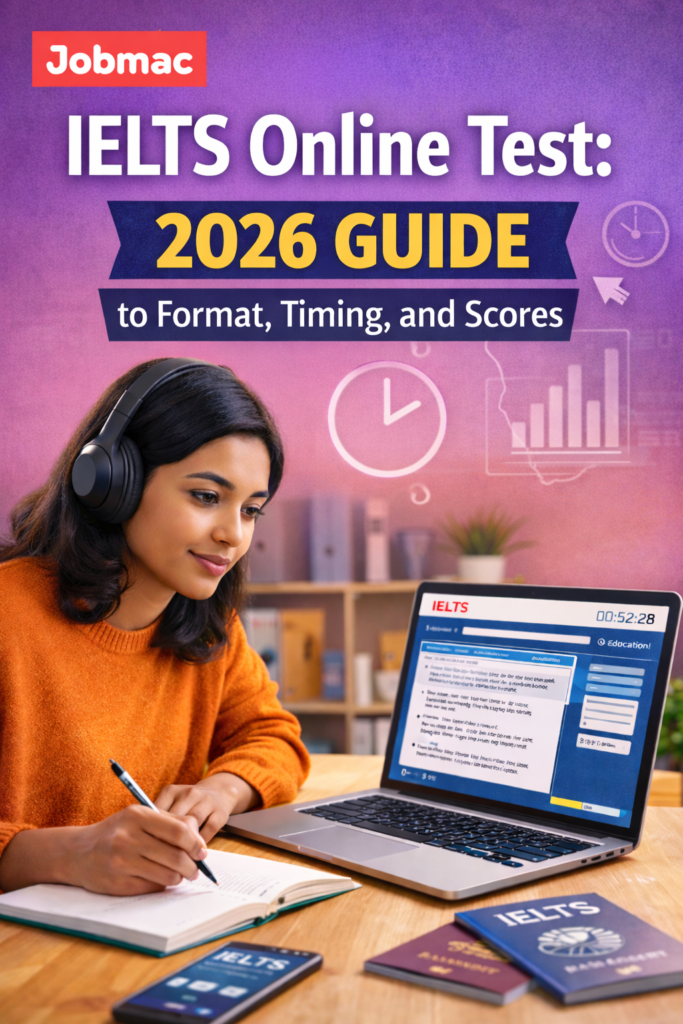
More people are choosing online testing to unlock study and work abroad. The IELTS online test meets that need with flexible at‑home scheduling and the same strict standards as test centers. You take Listening, Reading, and Writing on your computer, then complete Speaking in a live video call with a certified examiner. Results arrive in about 6 to 8 days.
This 2026 guide explains what has changed and what has not. IELTS Online keeps the familiar format, timing, and band scores from 1 to 9. Security checks, identity verification, and remote proctoring match test center rigor. Availability and booking windows continue to expand in eligible regions.
You will see how each section works and how long it takes. Listening runs 30 minutes with 40 questions. While reading, you spend up to 60 minutes with 40 questions, and writing takes approximately 60 minutes with two additional tasks. Speaking lasts about 11 to 14 minutes and is conducted live.
Clear scores matter when applying to universities, employers, and immigration bodies. We outline how your section bands combine into the overall score, what score ranges mean, and how fast results are delivered online. You will also learn practical setup steps for testing at home, from device checks to room rules.
Here is what comes next in this post: an overview of the test format, a breakdown of timing by section, a plain guide to band scores and result reports, booking and tech preparation tips for home testing, and key 2026 updates that affect your plan.
What Is the IELTS Online Test in 2026?
The IELTS Online test in 2026 is the official computer‑based version of the IELTS Academic exam that you take from home. It keeps the same format, timing, and band scoring as test centers. You complete Listening, Reading, and Writing on your computer with secure software, then meet a certified examiner for Speaking in a live video call. Universities accept IELTS Online as the same test standard as the in‑person Academic version. For the official overview, see the IELTS page on IELTS Online.
Key points to know:
- Same test content, timing, and scoring as IELTS Academic at a center.
- Remote proctoring, ID checks, and a locked browser protect test integrity.
- Speaking stays face-to-face, delivered by video with a trained examiner.
- IELTS Online currently covers the Academic test. General Training is taken at centers. See the differences in IELTS Test Types.
Differences Between Academic and General Training Versions
Choosing the correct version guides your prep and score use. The IELTS online test applies to the Academic version, while General Training is usually taken at test centers. Here is how they differ by section.
Practical advice:
- Pick Academic if you plan to study at college or university, or for a professional registration that asks for Academic.
- Pick General Training if you are migrating for work or settling abroad, unless your visa or employer asks for Academic.
- Confirm requirements with your target institution or visa body before booking. Use the official guidance on IELTS test types and regional pages, and check any school or immigration page directly. For a clear overview of typical use cases, see IDP’s guide on Academic vs General Training.
Tip: policies can vary by country and university. Always match your version to the exact score and test type listed in their admissions or visa instructions.
IELTS Online Test Format: Breaking Down the Sections
The Ielts online test mirrors the in‑center Academic format, only you take it from home. You complete Listening, Reading, and Writing on your computer with secure software, then meet a certified examiner by video for Speaking. Timings, sections, and scoring stay the same. For a concise official outline, see the British Council page on the IELTS test format and the IELTS overview of IELTS Online.
Listening and Reading: Key Question Types
Listening lasts 30 minutes with four parts, then you get extra time to check or review on screen. You hear a mix of monologues and conversations across everyday, training, and academic contexts. Audio plays once, so active focus is key.
Common Listening question formats:
- Multiple choice: Choose one answer, or sometimes two or three.
- Form/table completion: Fill in details from the audio.
- Map/plan labeling: Match places or features you hear.
- Matching: Link speakers, opinions, or items.
- Sentence completion: Complete statements with exact words.
Reading lasts 60 minutes with three long texts for Academic or a range of practical texts for General Training. You answer 40 questions with no extra transfer time, so pace matters.
Common Reading question formats:
· True/False/Not Given or Yes/No/Not Given
· Matching headings, features, or information
· Multiple choice
· Sentence or summary completion
· Table/flow‑chart completion
· Short‑answer questions
Quick practice strategies:
- Skim for structure first, then scan for details. Mark keywords.
- Follow order cues. Many tasks progress with the audio or text.
- Watch word limits. If it says “no more than two words,” do not add extras.
- Build a bank of synonyms. Questions often paraphrase the source.
- Simulate timing. Set 30 minutes for Listening and 60 for Reading to train pace.
Writing and Speaking: Task Details
Writing takes 60 minutes with two tasks. Task 2 is worth more, so plan accordingly.
- Task 1 (Academic): Describe a graph, chart, table, map, or process in at least 150 words. Make a comparison of data, avoid personal opinion, and then summarize the key trends
- Task 1 (General Training): Write a letter of at least 150 words. Match tone to purpose, such as formal for an official request or semi‑formal for a neighbor.
- Task 2 (both versions): Write a 250‑word essay. Present a clear position, support it with examples, and use coherent paragraphs.
Time management tips:
1. Spend about 20 minutes on Task 1 and 40 minutes on Task 2.
2. Plan briefly. Note the main points and paragraph order before you write.
3. Keep language precise. Favor clear verbs and consistent tenses.
4. Leave two minutes to check grammar, articles, and word choice.
Speaking sessions run 11 to 14 minutes, conducted face-to-face via secure video. It has three parts: introduction and general questions, a long turn with a cue card, and a deeper discussion.
Speaking guidance:
- Aim for natural, clear speech over memorized lines. Examiners score fluency, coherence, vocabulary, grammar, and pronunciation.
- Extend answers with reasons or short examples. Avoid one‑word replies.
- Use the one‑minute prep time in Part 2 to map a simple structure, such as introduction, two main points, and a brief close.
- Keep a steady pace and intonation. Self‑correct briefly if needed, then move on.
All timing and sections match the standard Academic exam. For confirmation of formats and durations, refer to the official pages for IELTS Online.
Timing and Scheduling for the IELTS Online Test
IELTS Online gives you control over test timing while keeping strict procedures. Listening, Reading, and Writing run in one sitting. Speaking is booked as a separate video appointment. Plan around your time zone, your tech setup, and your best focus window. Confirm availability and booking rules with the official pages for IELTS Online and the IELTS portal for booking your test.
How to Schedule Your Speaking Test
Speaking for the IELTS online test is flexible. You select a video slot that fits your calendar. In many regions, speaking can be on the same day or within a nearby date window. Times are displayed in your local time zone during booking.
Follow these steps to secure a smooth appointment:
1. Create or sign in to your IELTS account, then choose IELTS Online. Pick your Listening, Reading, and Writing date first, then select a Speaking slot from the available times.
2. Review the confirmation email. It includes your meeting link, time zone, and ID instructions.
3. Add a calendar reminder. Set alerts for 24 hours and 60 minutes before the appointment.
Common booking options:
- Choose from multiple daily slots, including mornings, afternoons, and evenings.
- Move to a different slot if your provider allows changes. Fees or cut-offs may apply, so check the terms before you change.
- Contact support early if you need accommodations. Documentation is usually required.
- Prepare your video setup so the interview feels natural and secure:
- Device and software: Use a reliable computer with a webcam and microphone. Update your browser and required test software. Restart the device on the day.
- Internet: Aim for stable, wired internet if possible. Close bandwidth-heavy apps. Keep your router nearby.
- Lighting and background: Face a light source. Keep the background plain and quiet. Remove clutter.
- Audio: Test your mic level and speaker volume. Use a simple wired headset if it improves clarity.
- Camera framing: Position your face and shoulders in the center. Keep eye level with the camera to show engagement.
- ID and room check: Have your valid ID ready. Be prepared for a 360-degree room scan. Keep the desk clear.
- Backup plan: Charge your device, plug in power, and keep a phone hotspot ready. Rejoin quickly if the call drops.
Timing pointers that help performance:
- Pick a slot when you speak your best. Many test takers choose late morning or early afternoon for peak focus.
- Allow a buffer before and after the interview. Rushing increases stress and can affect fluency.
- Log in 10 to 15 minutes early. Complete checks without pressure and settle your breathing.
Quick checklist before you join:
- Close notifications and messaging apps.
- Place your ID and water within reach.
- Keep a simple notepad and pen if permitted for Part 2 prep.
- Sit upright, relax your shoulders, and speak at a steady pace.
Booking and technical steps vary by provider and region. For official availability, payment, and ID rules, start with the IELTS page for booking your test.
IELTS Scores: How They Work and What to Expect
IELTS scores use the 1 to 9 band scale for each skill, with half bands. Your overall band is the average of Listening, Reading, Writing, and Speaking, rounded to the nearest half band. The IELTS online test uses the same scoring rules as the test center version. For the official method, see IELTS guidance on understanding your score and the British Council’s page on IELTS scores explained.
Understanding Band Scores for Each Section
Listening and Reading are marked out of 40. Your raw score converts into a band. Writing and Speaking are assessed with clear criteria. Use this quick view to see how raw scores align with bands.
Band equivalents for Listening and Academic Reading (approximate):
| Band | Listening Correct (out of 40) | Academic Reading Correct (out of 40) |
| 9.0 | 39–40 | 39–40 |
| 8.5 | 37–38 | 37–38 |
| 8.0 | 35–36 | 35–36 |
| 7.5 | 32–34 | 33–34 |
| 7.0 | 30–31 | 30–32 |
| 6.5 | 26–29 | 27–29 |
| 6.0 | 23–25 | 23–26 |
| 5.5 | 18–22 | 19–22 |
| 5.0 | 16–17 | 15–18 |
Notes that help you plan:
- These ranges are typical, not fixed. Conversions may shift slightly by test version.
- Example: 32 out of 40 in Listening usually maps to about Band 7.5.
- General Training Reading uses the same band scale, but conversion can differ.
- Writing and Speaking use analytic scoring with four equal criteria. Examiners assign a band for each, then average them for the skill score.
Writing criteria:
- Task achievement/response: Answer the task fully, cover all parts, and present a clear position.
- Coherence and cohesion: Organize ideas logically, use paragraphs, and connect points with clear linking.
- Lexical resource: Use precise words, avoid repetition, and select natural collocations.
- Grammatical range and accuracy: Use a mix of sentence types with control over tense and agreement.
Speaking criteria:
- Fluency and coherence: Speak smoothly, extend ideas, and stay on topic.
- Lexical resource: Choose accurate words and paraphrase when needed.
- Grammatical range and accuracy: Use varied structures without frequent errors.
- Pronunciation: Aim for clear sounds, stress, and intonation. Accent is fine if it does not reduce clarity.
Quick takeaways:
- Aim for consistency across all four skills. A balanced profile often raises the overall band.
- Small gains add up. Moving from 29 to 32 correct answers can shift your Listening band.
Conclusion
The Ielts online test in 2026 gives you the same format, timing, and band scoring as test centers, with secure at‑home delivery. You take Listening, Reading, and Writing on your computer, then complete Speaking in a live video call. Results arrive in about 6 to 8 days, and your overall band is the average of the four skills.
If you plan to study or work abroad this year, use the flexibility to your advantage. Book your date now, schedule speaking at your best focus time, and practice daily with strict timing. Keep a steady routine, track raw scores, and refine weak areas with short, focused drills.
Trust the process. The online option keeps high standards, adds convenience, and supports fair scoring. Confirm your target band with your university or employer, then align your prep and test date with that goal.
Start today. Visit official IELTS pages for booking, format details, and score policies, then set a weekly study plan. Your best result comes from clear steps, steady practice, and one confident test day.
![MIT Scholarships Guide [2025]: How to Apply and Win](https://jobmac.org/wp-content/uploads/2025/08/file_0000000038b46243b0f0c5fe02a3d783-1024x683.png "MIT Scholarships Guide [2025]: How to Apply and Win")