
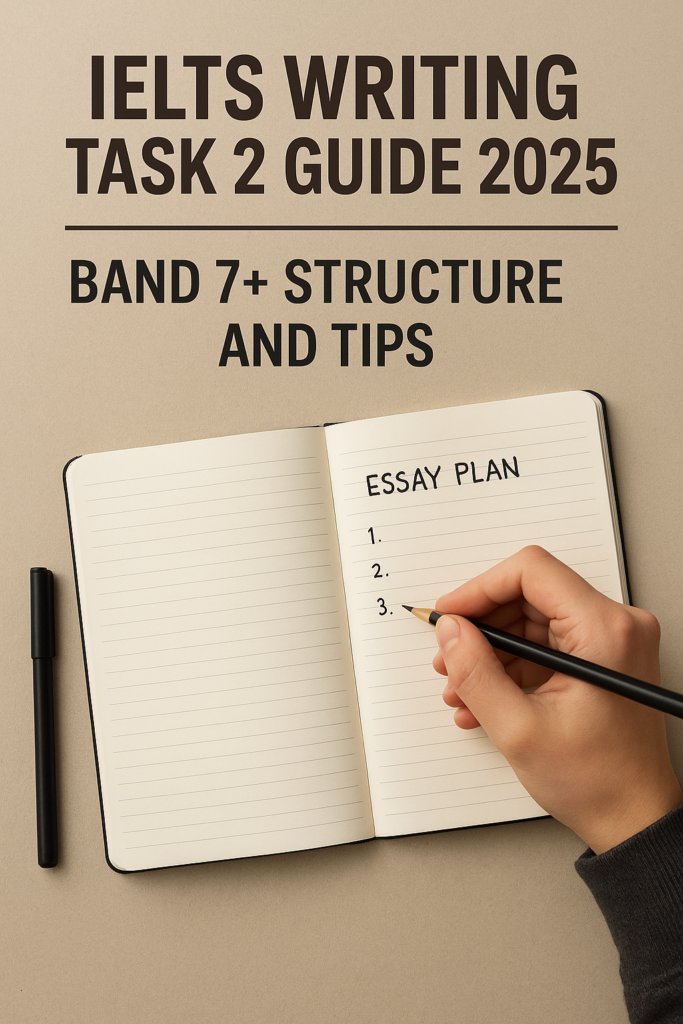
The IELTS writing task 2 2025 can shape your plans for study or work abroad. Administrative teams and employers look at your writing to judge for clarity, logic, and accuracy.
Band A and higher shows how you can present your ideas and support them with a sound argument
There are not many changes in 2025, but trends matter. These days, computer-based testing is now common in many centers, and One Skill
Retake is available in many regions. Main criteria stay the same , so you still need strong task response, cohesion and coherence, lexical resources, and grammatical range and accuracy.
This guide gives a clear Band 7 essay structure you can trust in the exam. You understand how to analyse the prompt, plan fast, write focused paragraphs, and use precise language.
You will also see models, outlines, and useful linking phrases that sound natural.
The goal is simple: write less fluff and more support. You will learn how to generate numerous ideas, develop them, and stay on topic. You will also get a checklist to avoid common errors like weak thesis statements, vague topic sentences, and repetition.
Here is what you will find next: a quick overview of the task, a step-by-step structure for Band 7+ timing tips, vocabulary and grammar advice, and frequent mistakes to avoid. Read on to build confidence and write a very clear, logical essay on test day.
Understand IELTS Writing Task 2 Basics for 2025
Understand the task, then write with purpose. Task 2 asks you to present a clear position, support it with reasons and examples, and stay on topic. You will write at least 250 words about 40 minutes.
The format does not change in 2025, so build habits you can trust under time pressure. Review recent prompts and themes to sharpen your instinct. For practice scan topic banks like 20 20 common essay topics for IELTS Writing Task 2
Common Question Types in IELTS Writing Task 2
- Spot the question type fast, then plan your structure. Most prompts fit into four main types.
- Opinion (agree or disagree): You take a position on a statement and defend it
- Quick ID tips to use in the exam
- Understand the command words: Agree or disagree, discuss both views, advantages and disadvantages, problems and solutions.
- Note the scope: people, governments, schools, or companies.
- Sketch a 30-second plan with your thesis and two main points. This stops drift and saves time later.
- Practice by labeling 10 prompts with the type and writing a one-sentence thesis for each. Pattern spotting speeds up planning and improves accuracy.
IELTS Band Descriptors: What Band 7+ Looks Like
- Examiners grade four areas: Task Response, Coherence, cohesion, Lexical Resources, grammatical range, and accuracy. A band 7 shows clear control across all four
- Task response: A Band 7 gives a clear position and supports it throughout. Ideas are relevant and extended with examples. No new idea in conclusion
- Cohesion and Coherence: information flows in a logical order. Paragraphs have clear topic sentences. Linking words are natural and not repetitive.
- Lexical resources: Vocabulary is varied and precise. word choice fits the task. Errors are rare and do not confuse the reader.
- Grammatical range and accuracy: You must use a mix of simple and complex sentences with good control. Errors are occasional and minor.
| Here is the quick comparison to show the jump from Band 6 to Band 7+ | ||
| Criterion | Band 6 | Band 7 |
| Task | Addresses task but may be uneven | Clear position from start to finsh |
| Response | Position may be unclear at times | Well developed suppor |
| Coherence | Some logic, but ideas can repeat Linking may be mechanical | Logical progression, clear paragraph Varied cohesion devices |
| Lexical | Adequate range, some repetition and errors | Wide range, precise word choice, minimal errors that do not hinder meaning |
| Grammar | Mix structures with regular errors | Variety of complex forms with good accuracy and control |
How to reach Band 7 in 2025
- Write a one-line thesis that answers the question. Keep it visible in your plan.
- Use a tight paragraph frame: topic sentence, explanation, example, mini conclusion.
- Vary linking: use words like “because.” For example, “as a result,” “ however.” In contrast, “overall,”
- Upgrade vocabulary with topic pairs: cause and effect, risk and benefit, cost and access, policy and practice.
- Mix sentence types: simple for clarity, complex for relationships, and conditions for analysis.
- Edit in the last 3 minutes: remove repetition, fix verb tenses, and check articles and plurals.
- Build these habits in practice, and you will write with clarity, focus, and control on test day.
Master the Band 7+ Essay Structure Step by Step.
You can master the Band 7+ Essay structure step by step by using a clear four-paragraph plan. You will write an introduction, two focused body paragraphs, and a concise conclusion. Keep ideas tight, sample openings, and review practical guideline lines.
Craft a Strong Introduction Paragraph
A strong introduction does three things: paraphrases the question, states your position or outlines the main points, and sets the scope. Keep it short, around 40 to 60 words, so you save time for development in the body paragraphs.
How to build it fast:
Paraphrase the task using synonyms and a changed structure to show range.
Give a direct thesis that answers the question.
Optionally, signpost your two main ideas.
Useful moves:
- Replaces key nouns and verbs with precise alternatives
- Change active to passive, or split complex clauses into simpler ones.
- Avoid uncommon idioms; use clear, topic-appropriate language.
Simple introduction for an opinion essay on technology impact
Many argue that modern technology improves daily life, while others claim it harms social ties and health. I believe digital tools, when used with limits, bring more benefits than risks, since they increase access to services and support better learning.
Keep the introduction lean, not a mini body paragraph. Two or three sentences are enough.
Smart synonym swaps that work:
- Improve, enhance, boost
- Harm, change, undermine
- Benefit, advantage, gain.
- Students, learners, pupils
- Society, community, the public
Develop Body Paragraphs with Clear Arguments
Make use of one main idea per paragraph. Start with a topic sentence that states the point. Follow with a short explanation, add a specific example, and end with a mini conclusion that links back to the thesis. Target up to 90 to 110 words per paragraph.
Paragraph plan:
- Topic sentence that advances your position
- Explanation that clarifies cause or effect
- Example or short case that feels real and relevant
- Mini conclusion that shows the impact
Linking phrases to keep the flow:
- Adding : in addition, also, besides
- Contrast: however, by contrast, on the other hand
- Result : therefore, as a result, this leads to
- Emphasis: above all, most importantly
Two-paragraph strategy:
Paragraph 1: your main argument. Make it the strongest point.
Paragraph 2: a supporting point or balanced counterpoint that you refute or limit with logic
Sample body paragraph on environmental issues:
Urban waste poses a serious threat to public health and local ecosystems. Many cities lack efficient recycling systems, which increases landfill use and pollutes waterways. For instance, poorly managed plastic disposal in coastal towns often leads to blocked drainage and floods during heavy rain.
This disrupts daily life, raises clean-up costs, and harms marine species. While critics argue that stricter rules may increase taxes, the long-term savings from cleaner neighbourhoods and reduced medical bills outweigh the short-term expenses.
Short practice checklist:
- Does the topic sentence state a clear idea?
- Did you include one concrete example?
- Do your links vary and sound natural, not repeated?
- Does the last line tie the idea back to your stance?
Write an effective conclusion.
The conclusion wraps up the essay. Restate the thesis in new words and summarize the two main points. Do not add new ideas or examples. End with a strong and final thought that shows the wider value or next step.
Simple structure:
- One sentence to restate your position
- One to two sentences to sum up your key reasons
- An optional final thought that signals priority or action
Sample conclusion that reinforces the message:
In summary, I hold that the responsible use of technology delivers more help than harm. It expands access to essential services and strengthens learning when paired with clear limits. Going forward, schools and families should guide use, so tools support progress without eroding well-being.
Tip for timing:
- Spend up to 3 minutes on the conclusion.
- Rewrite key ideas with fresh wording to show lexical control.
- Keep it crisp, around 30 to 45 words, unless the task needs a brief final remark. If you want a quick refresher on process and paragraph flow, review this step-by-step guide from IDP, IELTS Writing Task 2: 7 steps towards a band 7.
Proven Tips to Boost Your IELTS Writing Task 2 Score in 2025
Here are the proven tips to boost your IELTS writing task 2 score in 2025: focus on accuracy, flow, and clear ideas. Build habits now, so you write with control on the test day. The steps below target Band 7+ criteria and fit the structure you have already learned
Build Vocabulary and Grammar for Higher Bands
Strong vocabulary and clean grammar lift both lexical resources, grammatical range, and accuracy. Target topic families you see often: education, health, environment, technology, crime, society, and work.
Learn 10 to 15 high-value words per topic area each week. Include collocations like “public health burden,” “curriculum reform,” data, “data privacy,” “youth unemployment,” and “urban sprawl.
Build a personal bank of sentence frames. Examples: “one clear outcome is….” “ A more balanced view is that….” “ This pattern leads to….” “ A practical response would be….”
Practical complex sentences without errors. Use clause that shows cause, contrast, and conditions, but keep them tight. Example “Although online courses widen access, many learners still need in-person support to stay motivated
Daily exercises that improve range and accuracy:
- Paraphrase 5 Task 2 question in two ways each. Aim for precise synonyms, not rare words.
- Write 6 complex sentences using because, although, while, if, unless, and which. Check subject-verb agreement and comma use.
- Convert 3 long sentences into two shorter ones for clarity. Then join two short ones into a clean complex one.
- Build a mini collocation set for one topic. For work. Add pairs like job security, skill matching, remote policies,wage growth, and career progression.
- Do a 5-minute grammar spot check, scan for articles, plurals, prepositions, and consistent verb tenses.
Quick quality checks:
- Keep one idea per sentence.
- Prefer familiar, precise words over rare terms.
- Read aloud once to catch awkward phrasing.
Ensure Coherence with Linking Words
Linking words guide the reader through your logic. Use them to show addition, contrast, cause, result, and examples. Vary them, but keep them natural.
Useful connectors:
- In addition: also, in addition, besides
- Contrast: however, by contrast, on the other hand
- Cause: because, since
- Result : therefore, as a result, this leads to
- Example: for example, for instance, such as
- Clarification: in other words, that is
How they create flow:
- They show how ideas relate, so the reader never guesses your purpose.
- They mark a turn in the argument, which keeps the paragraph focused.
- They reduce repetition by replacing long transitions with compact signals.
Before and after example:
Before:
Many people prefer working from home. Offices are expensive to run. Some jobs need face-to-face contact. Companies keep hybrid models.
After:
Some people prefer working from home. However, offices are expensive to run, and some jobs still need face-to-face contact for training and trust. As a result, companies keep hybrid models, which balance cost control and team cohesion.
Before:
Public transport is crowded in cities. People buy cars for comfort. Roads get blocked. The air gets worse.
.
After:
Public transport is crowded in many cities. Because commuters seek comfort and control, more people buy cars. This leads to heavier traffic, and the air quality declines over time.
Tip for practice:
Underlying your linking words after you draft a paragraph. Replace any repeated item, like “however,” with a different, natural option the second time.
Practice Strategies and Sample Essays
Daily writing builds speed, structure, and confidence. Use a short, repeatable routine that fits a 40-minute test window.
A simple plan for one essay per day:
- Pick a recent task 2 prompt. Set a 40-minute timer.
- Spend 5 minutes planning your thesis and two main points.
- Write four paragraphs. Keep the introduction 2 to 3 sentences, and the conclusion 2 to 3 sentences.
- Use the last 3 minutes to fix verbs, articles, and repeated words.
Review with the band criteria:
- Task response: Clear position, fully relevant support
- Coherence and Cohesion: Logical order, varied linking, no jumps
- Lexical resources: Precise, topic-appropriate vocabulary with minimal repetition
- Grammar: Mix of simple and complex sentences with high accuracy
Self-assessment method:
- Highlight your thesis and topic sentences. Do they match?
- Mark one example per body paragraph. Is it specific and on point
- Circle all linking words. Swap any overused items.
- Track three recurring errors, then fix them the next day.
Weekly progress targets:
- 7 essays, 2 rewrites of your weakest essays, and 1 focused grammar review
- One timed vocabulary drill per topic set, 10 to 15 items
- One coherence check is where you rewrite a paragraph to improve flow without adding new ideas.
- Stay consistent , short reps every day beat long, irregular sessions.
Avoid Common Mistakes in IELTS Task 2 for Band 7+ Success.
Avoid common mistakes in IELTS Task 2 for Band 7+; success begins with control. Small slips in focus, balance, and timing can drag a strong essay down. Keep your writing aligned with the prompt, maintain development across all paragraphs, and set aside a few minutes to check.
Steer Clear of Off-Topic Answers
Writing off the topic weakens the task response and lowers your score. Read the question with purpose, then mark what you must answer and what you can ignore.
Analyze the question in three pages:
- Task word: agree or disagree, discuss both views, advantages and disadvantages, problems and solutions
- Scope: who or what is in focus, such as governments, schools, companies, or individuals
- Limit: time frames, place, age groups, or conditions that narrow the topic
Use a 30-second keyword routine:
- Underline the task words.
- Box the scope and limits.
- Draft a one-line thesis that answers the exact task.
Quick example:
Prompt: “So many people expected university to be free for all students”.
Keywords: discuss both views, give your opinion, university, cost
Thesis sample: “University fees should be shared between the state and students because shared cost protects access and maintains quality
Keep a practice loop with past papers:
- Label 10 prompt by type. Write a one-sentence thesis for each.
- Extract 3 to 5 keywords per question and check them against your thesis.
- Write a 3-bullet plan before drafting. Matching each bullet to a paragraph
- Track drift in a log. Note which sentences went off topic and why
Balance Your Essay and Manage Time
An unbalanced essay, even with good language, risks Band 6 overdeveloping one paragraph or ignoring a required view hurts Coherence and Task Response.
Keep balance across common question types:
Opinion: Take a clear stance, then support it with two distinct reasons
Discussion: Present both views with equal weight, then state and justify your opinion
Advantages and disadvantages: cover both sides, then state and justify your opinion
Problem and solution: Pair each main problem with a practical solution
Use the 5-35-2 plan to control flow:
- 5-minute plan: Thesis, two main points, and one example per paragraph. Write a skeleton outline in the margin.
- 35 minutes write: Four paragraphs, 260 to 290 words, keep each body paragraph close to the same length
- 2-minute check: Fix verbs, articles, plural forms, and repeated words. Confirm every sentence links to the thesis.
Practical safeguards:
Limit yourself to two body paragraphs. This keeps development even and focused.
Cap each example at two sentences. Avoid long stories
Stop at your planned word target. Extra words rarely add value under time pressure.
Mirror structure: topic sentence, explanation, example, mini conclusion in both body paragraphs
Fast checklist before you move on:
- Is your position clear in the introduction and conclusion?
- Do both body paragraphs develop different points, not the same idea twice?
- Did you answer all parts of the task, such as discussing both views, plus your opinion
- Did you leave 2 mins to correct easy errors?
- Use these controls every time you practice. They build habits that hold up in the test room.
Conclusion
IELTS Writing Task 2 Guide 2025, Band 7+ Structure and Tips, points you to IELTS success 2025 with a simple plan you can trust. You know the task, the question types, and the band goals.
You have a four-paragraph frame, linking tools, and clean language habits. You also have timing steps, balance checks, and a list of mistakes to avoid
Start today, pick one recent prompt, plan for five minutes, then write for thirty-five. Keep two focused body paragraphs, then end with a clear final thought. Edit for verbs, articles, and repeated words. Track your errors and fix them tomorrow
A Band 7 or higher opens the door to study, work, and visas abroad. Strong writing shows clear thinking, which admission teams and employers value. Commit to daily practice, and your score will rise with steady gains.
Try the next step now. Write a 260 to 290-word essay from a current prompt. Subscribe to weekly guides, new topics, and checklists for 2025. Thank you for reading, and keep building the habits that win on the test day
![MIT Scholarships Guide [2025]: How to Apply and Win](https://jobmac.org/wp-content/uploads/2025/08/file_0000000038b46243b0f0c5fe02a3d783-1024x683.png "MIT Scholarships Guide [2025]: How to Apply and Win")