
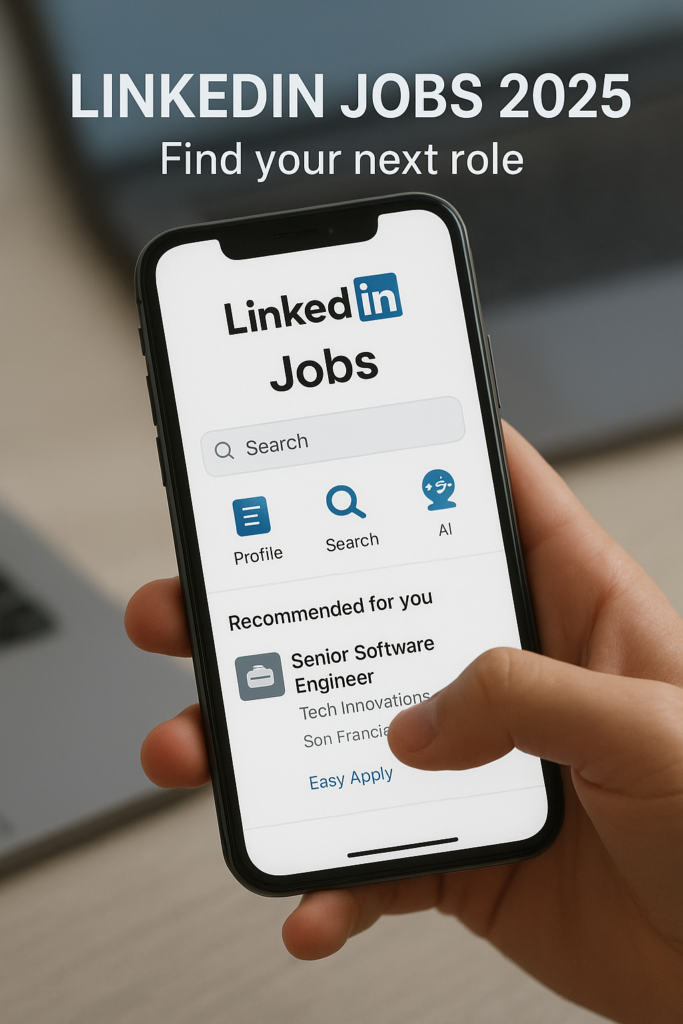
Hiring is tight in 2025, and competition is sharp. If you want to reach, speed, and quality roles in one place, LinkedIn Jobs is still the best bet. Recruiters live here, hiring teams post here, and the search tools keep getting smarter.
This guide shows you what works now. You’ll learn how to tune your profile so it ranks in search, how to write a headline that gets clicks, and which skills help you show up in recruiter filters.
We’ll cover smart search tactics, saved alerts, and when to use Easy Apply versus a full application.
AI features are a big boost this year. You can search in plain language, get suggested roles that match your goals, and see how your profile stacks up against a job description. LinkedIn can also suggest skills to add and prompts to tighten your resume bullets. Used well, these tools save time and improve match quality.
We’ll break down trends worth watching, like fast-growing roles, rising skills, and what signals matter to hiring teams. You’ll see how to target the right keywords, tailor your experience to each posting, and build proof with projects, media, and recommendations. Expect simple checklists, examples, and quick wins you can use today.
By the end, you’ll have a clean profile, a repeatable search plan, and a sharper application flow. You’ll know how to work with AI without sounding generic. Most of all, you’ll have clear, actionable steps to land your next role with LinkedIn Job.
Why LinkedIn is Your Best Bet for Job Hunting in 2025
If you want reach and signal in one place, use LinkedIn. Recruiters start here, review here, and message here. Reports show that over 95% of recruiters go to LinkedIn first, driven by skills-based search and AI workflows that speed up outreach.
See LinkedIn’s research on AI-assisted recruiting and quality-of-hire lift for context in 2025 trends in the Future of Recruiting..
The platform also pushed useful updates this year. You get AI-driven job matching based on skills, new job collections by industry and type, and clearer tags for remote, hybrid, and onsite roles.
Recruiters now use personalized outreach tools, which means better-targeted messages for candidates who match the skills and intent.
Key Features Powering Your Search
AI makes the search smarter and faster. LinkedIn reads your skills, titles, and recent activity, then suggests roles that fit, even when titles vary. You will see stronger matches for emerging skills and adjacent roles you might miss.
- Use filters to tighten your results without losing range:
- Location and workplace: City, remote, or hybrid keep your list relevant.
- Experience level: Entry, associate, mid-senior, or director save time.
- Job type: Full-time, contract, internship, or temporary.
Set smart job alerts for daily or instant notifications. Choose a few high-intent keywords, not dozens, so you get focused updates. Add alerts to job collections for your field to catch new postings early.
Quick tips to get more quality matches:
- Tune your skills: Add skills pulled from target job descriptions.
- Use plain-language search: Try “senior data analyst remote Python” and refine.
- Follow companies: Signal interest and trigger better recommendations.
- Apply early: Alerts help you hit the first 24 hours, which boosts response.
Build a Profile That Attracts Recruiters Fast
You want recruiters to find you, scan fast, and say yes. Build a profile that is clear on role fit, rich with proof, and easy to read on mobile. Hit the basics first, then add signals that AI and humans both trust.
Optimize for AI and Human Eyes
AI reads your profile like a structured resume. Keep sections complete and formatting consistent.
Headline: match target titles. Example: “Senior Data Analyst | SQL, Python, Looker.” See headline advice in this guide, 12 steps to a better LinkedIn profile in 2025.
About: 3 to 5 tight lines with impact. Use keywords from job descriptions. Add scope, tools, and outcomes.
Experience: start bullets with strong verbs and numbers. Example: “Cut cloud spend 22% using FinOps policies.”
Skills: list core, adjacent, and 2025 trends like AI literacy, prompting, sustainability reporting, data privacy.
Proof: upload media. Add project links, slide decks, code repos, or
Endorsements and recommendations: ask teammates and managers for short, results-focused quotes.
AI ranking favors clear role labels and relevant skills. For a quick checklist on targeting, review this take on AI recruitment filters, How to Optimize Your LinkedIn Profile for AI Recruitment.
Human scan matters too:
Photo: friendly, high-contrast, simple background.
Activity: post short insights weekly, comment with value, and share wins.
Mobile: keep lines short, avoid walls of text, front-load keywords.
Network Smartly to Unlock Hidden Jobs
- Most hires flow through people. Your goal is warm intros and referrals.
- Connect with alumni and ex-colleagues. Send a single, personal line that shows context.
- Join 2 to 3 active groups in your niche. Share tips, answer questions, and DM helpful follow-ups.
- Engage in comments on company and leader posts. Add one clear point, not fluff.
- Follow target companies to spot early roles and signal interest.
- Use InMail wisely. Keep it short, relevant, and specific to the team’s goals. In 2025, use AI to draft, then rewrite in your voice. Add one proof point and one ask.
Want more context on off-market roles? Scan this overview on the hidden job market, Cracking the hidden job market.
Aim for real relationships, not transactions. Give value first, then ask for a referral when there is a fit.
Spot 2025 Trends and Apply Like a Pro
Hiring teams are moving fast in 2025. Roles tied to AI, data, sustainability, and trust keep growing, while hybrid work stays the norm in knowledge roles. Use these trends to focus your search and tighten every application.
Top In-Demand Roles to Target
Aim for roles with clear growth, strong budgets, and cross-industry demand. Build skills that map to current hiring signals.
AI/ML Engineer: Surging demand across sectors. Strong growth in LinkedIn’s fastest-growing jobs lists. Skills: Python, PyTorch or TensorFlow, MLOps, model eval, and prompt engineering. Align past automation or analytics wins to model impact.
Data Scientist or Analytics Lead: Data spend is still rising as teams push for ROI. Skills: SQL, Python or R, experimentation, BI tools, causal methods, stakeholder storytelling. Tie results to revenue, churn, or cost.
Cybersecurity Analyst: Breach risk drives steady hiring. Skills: SOC workflows, SIEM, threat intel, IAM, incident response, cloud security. Link experience to mean time to detect and resolve.
Cloud or DevOps Engineer: Companies optimize costs and reliability. Skills: AWS or Azure, Kubernetes, IaC, CI/CD, observability, FinOps. Show uptime, cost cuts, or deploy speed.
Sustainability Specialist: Regulations and investor pressure boost hiring. Skills: GHG accounting, CSRD, SEC climate, LCA, ESG data tools. Connect projects to emissions reduction or audit readiness.
Product Manager, AI or Data: Teams need builders who ship value with AI. Skills: discovery, prioritization, metrics, LLM integration, privacy by design. Show adoption, revenue, or time saved from shipped features.
Healthcare Roles (RN, PT, Care Ops): Aging population keeps demand high. Skills: patient outcomes, care coordination, EHRs, quality metrics. Quantify patient throughput and satisfaction.
Scan current lists for proof points and skill ideas in LinkedIn’s reviews of the world’s fastest-growing jobs and the latest skills on the rise. Hybrid roles dominate tech, product, data, and design. On-site remains common in healthcare and manufacturing.
Pro Tips for Standing Out in Applications
- Make every click count. Small changes raise your response rate.
- Craft your resume and cover letter for the job. Mirror the title and 6 to 8 core skills from the description.
- Lead with quantifiable wins.
- Use Easy Apply for tight fits. For priority roles, submit the full application on the company site and message the hiring manager or recruiter with one proof point.
- Avoid generic summaries, vague bullets, and skill dumps without outcomes.
- Match skills to outcomes. Pair “Kubernetes” with “reduced deploy time 40%.”
- Track applications in LinkedIn: save jobs, set alerts, and mark each stage. Add reminders to follow up in 5 to 7 days with a short, value-focused note.
- Prep interviews with LinkedIn Learning modules tied to your role. Practice the STAR method, keep answers concise, and bring two metric-backed stories for impact, one for failure, one for teamwork.
- Tight targeting, clear numbers, and smart follow-up win more replies.
Conclusion
You have what you need to win on LinkedIn Jobs this year. Tighten your profile for skills-based search, write a headline that draws clicks, and showcase proof that earns trust.
Use smart filters, saved alerts, and AI matching to spot high-fit roles fast. Target growth tracks tied to AI, data, cloud, security, and sustainability, then link every skill to a clear result.
Start now. Update your headline and About, add five high-signal skills, and pin three proof pieces. Follow ten target companies, set two focused alerts, and queue one tailored application you can send today.
Add a brief note to a hiring manager that highlights one metric and one way you can help.
Keep your loop tight. Apply early, track progress, follow up with value, and keep improving based on responses. Post one short insight this week to show your voice and spark warm intros. Small, steady actions compound into momentum.
Hiring is tight, but you have an edge if you act with intent. Get visible, stay consistent, and let your results speak. Your next role is closer than it looks.
Thanks for reading. Share what worked for you in 2025, drop questions in the comments, or pass this to someone who needs a lift.

![MIT Scholarships Guide [2025]: How to Apply and Win](https://jobmac.org/wp-content/uploads/2025/08/file_0000000038b46243b0f0c5fe02a3d783-1024x683.png "MIT Scholarships Guide [2025]: How to Apply and Win")